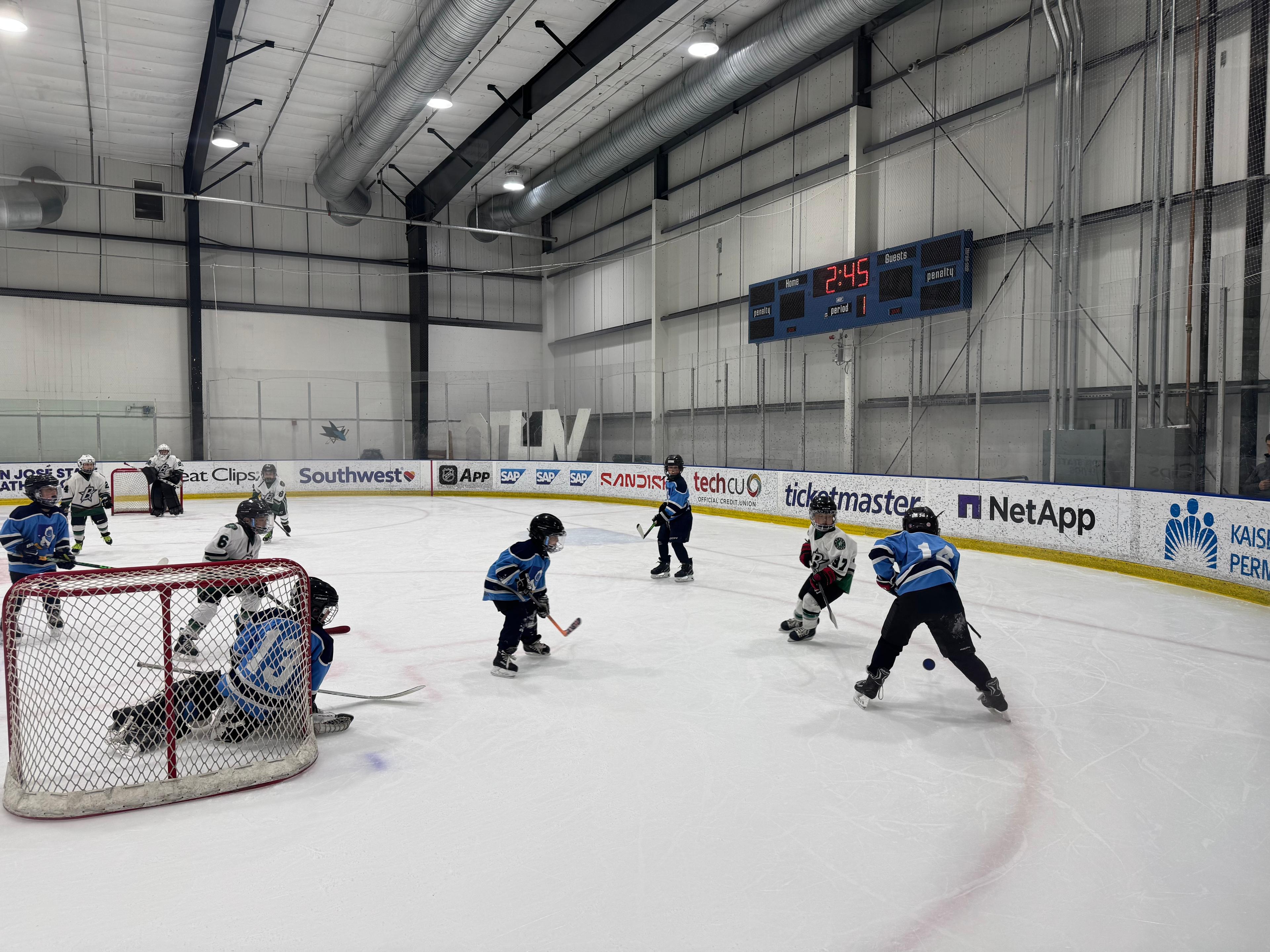
Act 1 — The Team: We Crossed a Line
There is a rule in youth hockey nobody talks about openly — the Mercy Rule. When you are losing by too many goals, the game ends early. Last season, that happened to us more than once. Scores like 1–27. There is no way to pretend those games were close.
This tournament was different.
We went 2–5 across our games. That is still more losses than wins. But when I look at the numbers the right way, I see something else: we are no longer getting mercy-ruled. The games are competitive now. The gap between us and the other teams is closing — not because we got lucky, but because we are becoming a real team.
That shift matters more than the win column.
Act 2 — My Physical Engine
I have an advantage that most players on the ice do not have: I also train as a speed skater.
Speed skating builds a different kind of leg. The angles, the power positions, the sustained output over distance — it trains muscles that most hockey players never isolate. When I am on the ice, my legs feel strong. My endurance holds up through three periods when other players start to fade. One coach pressed his hand against my quad after practice and said my muscles felt like stone. That is not an accident. That is the cross-training.
I can also cover ice quickly. My top speed and my ability to maintain pace late in a shift are real edges.
But here is what I have been studying on my own: I watch NHL players — their footwork, how they carve turns, how they slow down without stopping momentum. I try to copy what I see. I have learned that watching closely and then doing it on the ice is how technique actually gets installed.
Act 3 — The Technical Gap: Feet Faster Than Hands
This is where the self-analysis gets honest.
My feet are faster than my hands. That sentence sounds like a compliment. It is not — not yet. What it means in practice is that I can move into position, but by the time I get there my puck control has not kept up. During hockey stops, I am sometimes losing the puck at the moment of deceleration. During weight shifts — especially edge-to-edge transitions — my hands fall behind the speed of my body, and I lose possession at exactly the wrong moment.
Speed without control is not a weapon. It is a liability.
There is a second problem: my defensive positioning. When I am defending, I have a tendency to overcommit — to go after the puck carrier instead of holding my ground. A smarter defender skates backward, reads the play, and forces the attacker into a bad decision. Patience in defense is harder than aggression. It requires trusting that good positioning will create the opportunity, rather than chasing it.
This is what Intelligent Athleticism means to me: knowing not just how fast you can go, but when to slow down.
Act 4 — The Training Target
The gap I am training to close is not physical. My engine is already there. The next level is craft — the technical precision that makes the engine useful.
Three specific things I am working on:
The NHL players I watch have all of this. It looks effortless because they have drilled it until it became automatic. That is the process.
**Training focus going forward:** close the gap between physical speed and technical control — specifically in hockey stops, weight-shift transitions, and backward defensive positioning. The engine is ready. Now build the craft to match it.